
Note:
- ACP - Applicable Coal Price.
- GCIN - globalCoal Newcastle.
- Forecast as of 5 June 2026.
- Base case refers to emerging conflict, moderate case refers to escalating conflict, and high case refers to severe conflict.

AFA mechanism promotes more transparency, cost-reflective, cost-efficient and reduce the timing gap in fuel prices and foreign currency exchange.
When fuel price increase/decrease, AFA will reflect accordingly.
In summary, AFA mechanism helps to better manage the fuel price volatility.
As published by TNB in its website, AFA for July 2026 is recorded as a surcharge of RM 377 million (equivalent to 3.59 sen/kWh). The surcharge is mainly due to higher fuel prices, which resulted in increased generation costs during the period.
To mitigate the impact of rising fuel costs on consumers, 35% of the increased cost (i.e. RM206 million, equivalent to 1.96 sen/kWh) is absorbed through the Kumpulan Wang Industri Elektrik (KWIE) fund. Consequently, the remaining 65% of the AFA surcharge, amounting to RM377 million or 3.59 sen/kWh, will be passed through to electricity consumers. This approach helps cushion consumers from the full impact of higher fuel prices while maintaining the sustainability of the electricity supply industry.
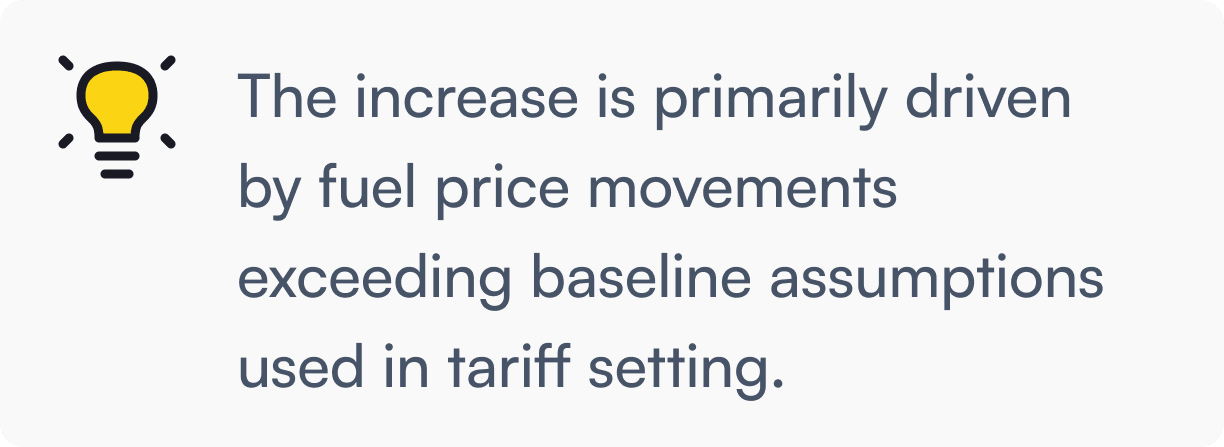
In July 2026, fuel prices are higher than the baseline prices used in tariff setting, resulting in an overall increase in generation costs.
The coal price for July 2026 is recorded at 122.37 USD/MT (Base price: 97 USD/MT). Based on the exchange rate of 3.9455 RM/USD for July 2026, this translates to a coal price of 22.12 RM/mmBTU (Base price: 19.14 RM/mmBTU at 4.307 RM/USD)
The Tier 2 gas price for July is recorded higher than the Base price:
Following the least-cost dispatch principle, the system fully utilised all available generation sources, including coal, gas, solar, alternate fuel, hydro and interconnection.
In April 2026, the electricity demand reached its maximum level for 22 times, with the highest peak demand recorded at 21,469 MW on 23 April 2026 at 8:30 PM. The increase was mainly driven by change in weather conditions.
Consequently, actual generation costs for April 2026 increased by 16%, driven by:
This increase has impacted the July 2026 AFA, which reflects a higher energy cost true-up adjustment.
As published by TNB in its website, AFA outlook from August to October 2026 is projected to range from +8.04 sen/kWh to +8.94 sen/kWh. This projection is based on the Base Case (Emerging Conflict) scenario, which higher fuel prices are expected to contribute to increased generation costs during the period.
In the latest outlook, fuel prices are trending upward, reflecting the impact of the geopolitical event (US-Israel-Iran conflict).
~129 USD/MT equivalent to ~24 RM/mmBTU, based on exchange rate of ~4.02 RM/USD (prior conflict forecast price is ~123 USD/MT equivalent to ~22 RM/mmBTU, based on exchange rate of ~3.95 RM/USD)
Above 4.00 RM/USD (prior conflict forecast exchange rate is 3.95 RM/mmBTU)

AFA is a mechanism under the Incentive-Based Regulation (IBR) framework that allows for automatic monthly adjustments to reflect the variation (either rebate or surcharge) in the variable component of the Energy Charge, where it is subjected to the (i) movement in the global fuel prices (e.g. coal & gas) and (ii) movement in the foreign currency (e.g. USD to RM).
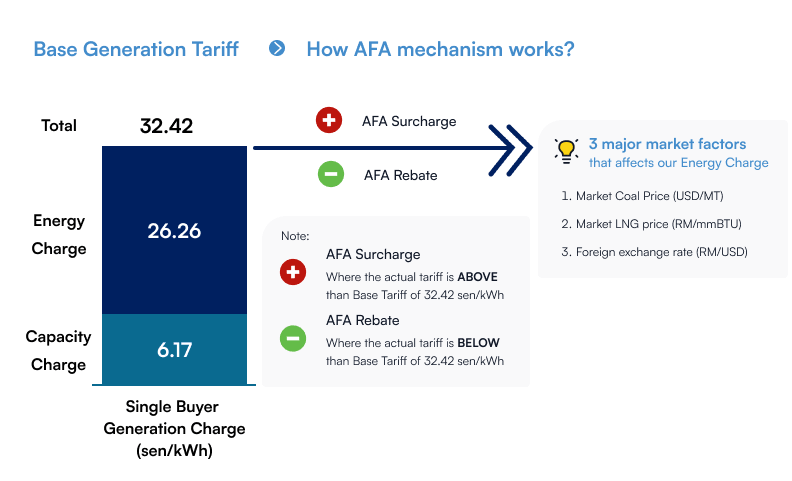
AFA mechanism promotes more transparency, cost-reflective, cost-efficient and reduce the timing gap in fuel price and foreign currency exchange.
The monthly AFA helps to:
1. Reflects current fuel prices
AFA stays aligned with current market conditions
2. Improves transparency
Customers can see that the increase or decrease of AFA is tied to fuel price movements
AFA reflect monthly adjustment to electricity tariff based on the fuel cost changes driven by movements in the global fuel prices and foreign exchange rate.
The difference between Imbalance Cost Pass-Through (ICPT) and AFA are tabulated as below: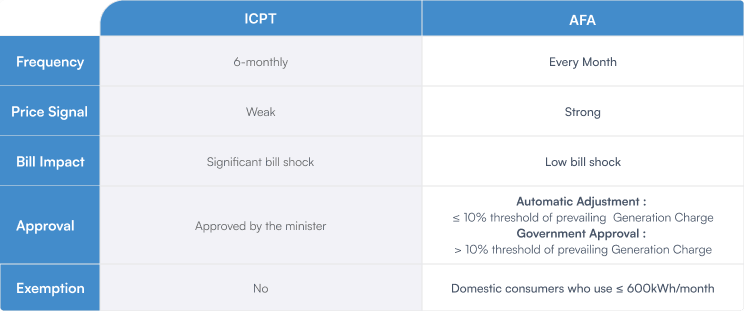
AFA is calculated by comparing the actual fuel cost used in electricity generation against the base fuel cost set in the tariff. If actual costs are higher, a surcharge is applied; if lower, a rebate is given.
Coal
97 USD/MT equivalent to 19.14 RM/mmBTU (based on exchange rate of 4.307 RM/USD)
Gas
AFA is influenced by movements of fuel prices and exchange rate, system conditions (i.e. generators availability, weather conditions which will affect hydro lake levels and solar generation), as well as geopolitical events.
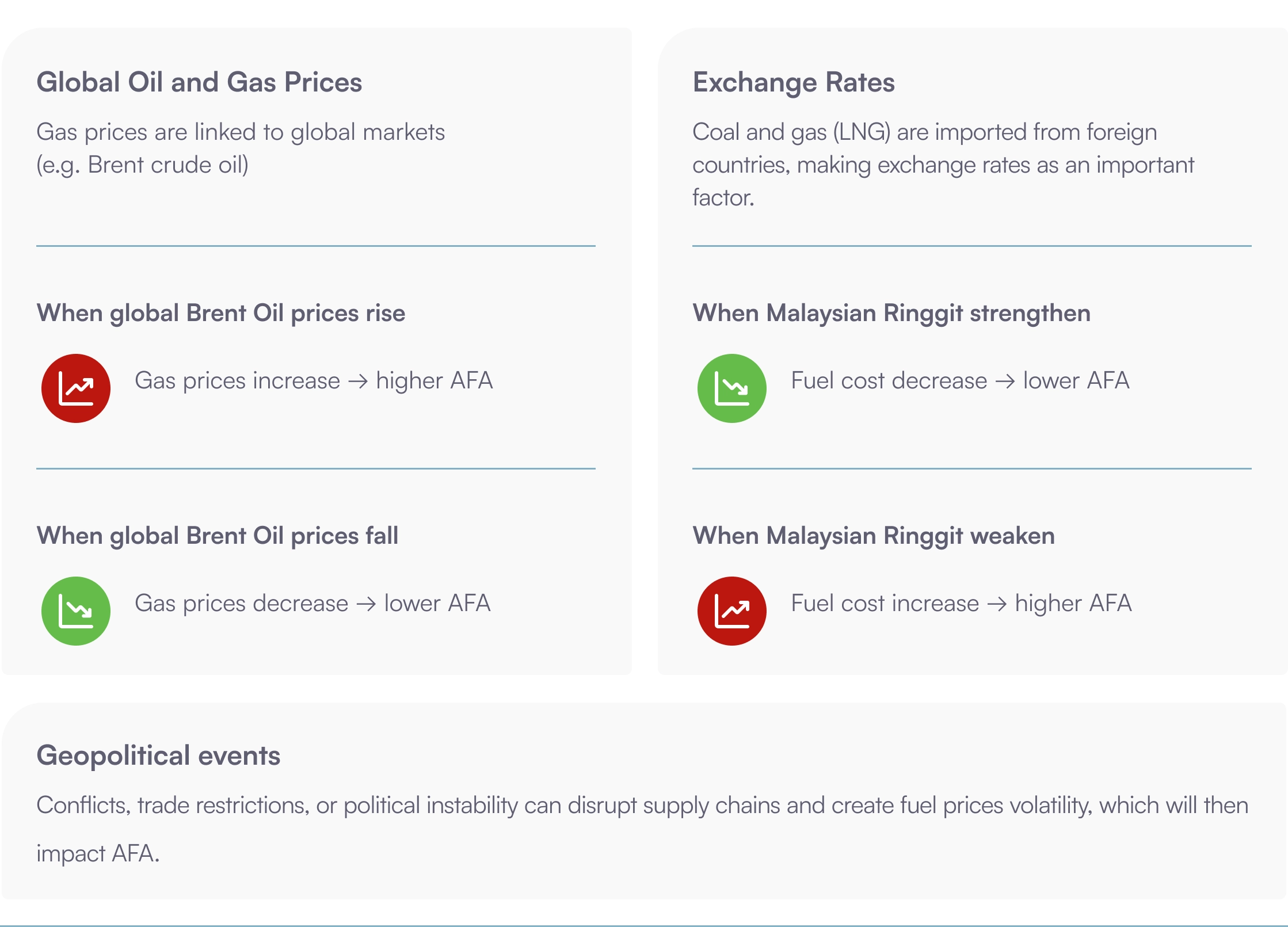
For instance, when coal and gas prices increase above their base prices, the cost of generating electricity rises, which contributes to a higher AFA rate.
Global factors such as supply-demand conditions, currency movements, and geopolitical developments can influence fuel prices, which in turn affect AFA as illustrated further below: