

CREAM
Community Renewable Energy Aggregation Mechanism
Understanding CREAM
The Malaysian government launched the Community Renewable Energy Aggregation Mechanism (CREAM) in March 2025 to expand access to green electricity across the country.
Built on the principle of open grid access, this programme aggregates rooftop spaces from residential premises for renewable energy generation, supplying clean electricity directly to local green consumers.


CREAM Implementation Framework
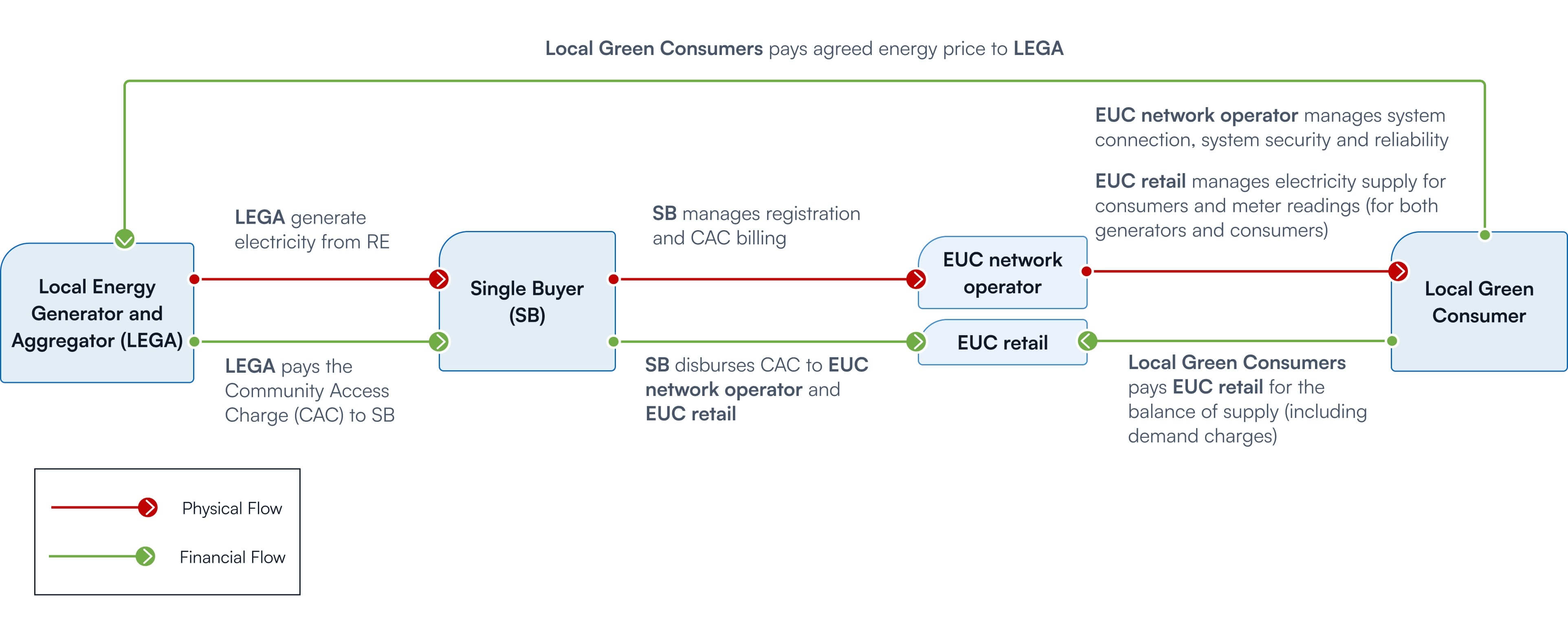
CREAM Contractual Framework
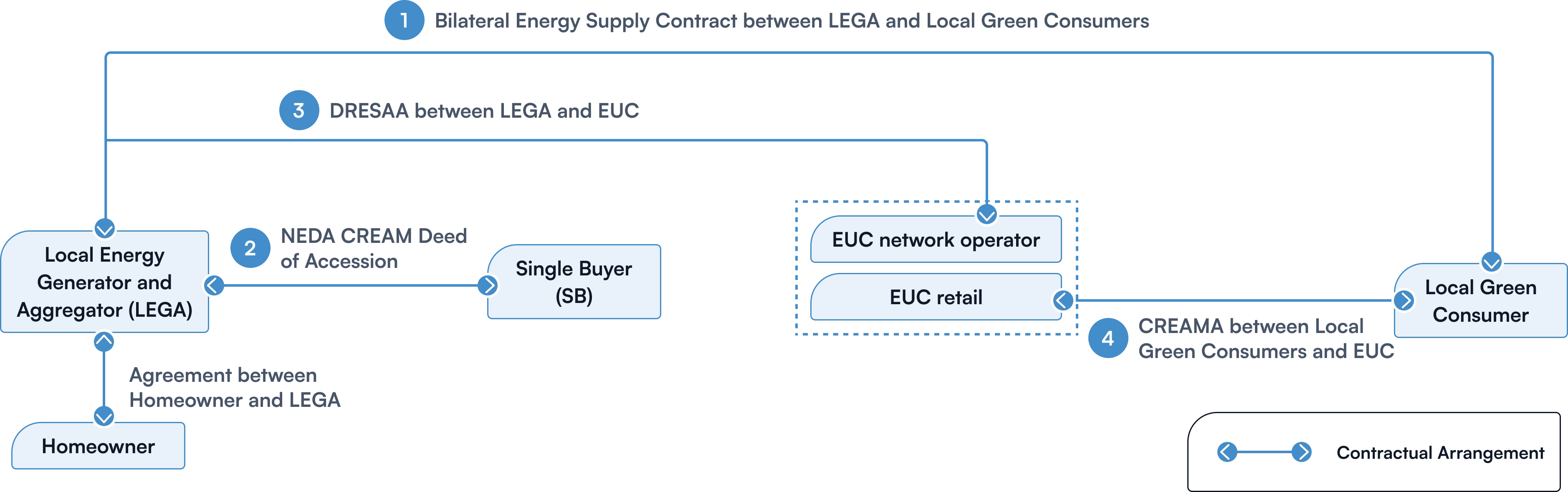
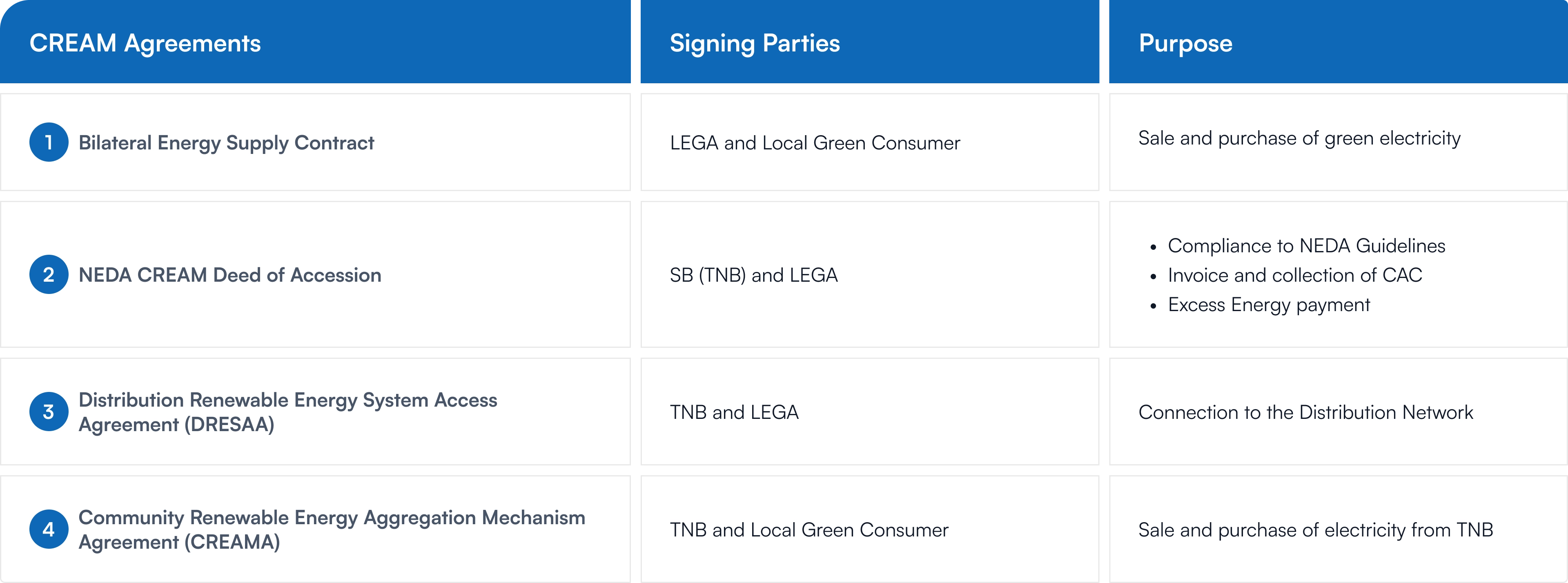
Overview of CREAM Application Process

-
CREAM registration
Purpose: Formally register the project and initiate participation under CREAM.
What happens:
- The Local Energy Generator and Aggregator (LEGA) registers the project on the Single Buyer platform and uploads the required supporting documents.
- The completed registration form and supporting documents are submitted to Single Buyer and Suruhanjaya Tenaga (ST).
- Upon successful submission, Single Buyer issues a registration reference number to LEGA and TNB Distribution Network (DN).
Outcome: The project is formally registered and recorded for review.
Document checklist:
- LEGA Documents
- Company profile and the relevant supporting documents
- Certified copy of SSM registration
- Bank statement (account number as stated in Part 1.2 of NEDA registration form)
- Declaration of LEGA (as per NEDA registration form)
- Copy of executed and stamped Land Lease Agreement/Land Title/Sale and Purchase Agreement
- Copy of rooftop lease agreement with Homeowners
- Corporate Authorization to participate in NEDA
- Copy of executed and stamped Bilateral Energy Supply Contract between LEGA and the LGC
- Local Community Solar Plant (LCSP) project details including project costs, preliminary technical specifications, relevant drawings and project schedule (as specified in Part 2.6.4 of the registration form)
- Decommissioning plan of the LCSP
- NEDA registration form is duly completed & declaration form signed
- LGC Documents
- Company profile and relevant supporting documents
- Certified copy of SSM registration
- Document proof of company status - as stated in the NEDA registration form
- Declaration of LGC (as per NEDA registration form)
-
Power System Study (PSS)
Purpose: Assess system impact and confirm technical feasibility for grid connection.
What happens:
- TNB Distribution Network conducts a full-fledged Power System Study for the proposed project.
- Upon PSS approval:
- LEGA updates the final approved capacity in the online registration form.
- LEGA uploads the PSS approval letter and submits the PSS report to Single Buyer and ST.
Outcome: System impact and connection feasibility are technically assessed and approved.
Document Checklist
- PSS approval letter from EUC
- Copy of PSS report
-
Registration Verification
Purpose: Confirm the completeness and accuracy of registration information.
What happens:
- Single Buyer reviews the updated registration data and supporting documentation.
- Final checks are performed to ensure alignment with CREAM requirements.
- Single Buyer issues a registration verification letter to LEGA and notifies ST.
Outcome: The project’s registration status is verified and confirmed.
-
Execution of NEDA CREAM Deed of Accession (DoA)
Purpose: Formalize participation under the CREAM framework.
What happens:
- Single Buyer issues the NEDA CREAM Deed of Accession to LEGA.
- LEGA executes the Deed and returns the stamped agreement to Single Buyer.
- Indicative timeline: Up to 80 days
Outcome: Participation under the NEDA CREAM framework is contractually established.
-
Execution of DRESAA, CREAMA and BCA
Purpose: Establish access, commercial, and billing arrangements.
What happens:
- LEGA executes the Distribution Renewable Energy System Access Agreement (DRESAA) with TNB Distribution Network.
- The Local Green Consumer (LGC) executes the Community Renewable Energy Aggregation Mechanism Agreement (CREAMA) with TNB Retail.
- LEGA and LGC execute the Billing and Collection Agreement (BCA) with TNB Retail, where applicable.
Outcome: All access and commercial agreements required for CREAM participation are in place.
Document checklist
- Copy of executed and stamped NEDA CREAM Deed of Accession (DoA)
- Copy of executed and stamped Distribution Renewable Energy System Access Agreement (DRESAA) (between LEGA and EUC)
- Copy of executed and stamped Community Renewable Energy Aggregation Mechanism Agreement (CREAMA) (between LGC and EUC
- Copy of executed and stamped Billing and Collection Agreement (between LEGA, EUC and LGC) - if applicable
-
NEDA Generation License Application
Purpose: Obtain regulatory approval for generation operations.
What happens:
- Approximately three months prior to the expected Commercial Operation Date (COD), LEGA applies online to Suruhanjaya Tenaga for a NEDA Generation License (Public Installation).
- Indicative timeline: Up to 90 days
Outcome: Regulatory approval to operate as a licensed generator is obtained, subject to ST approval.
-
Firm Participation Date
Purpose: Enable formal participation and energy export under CREAM.
What happens:
- Following the Initial Operation Date (IOD), completion of COD testing, and issuance of the Commissioning Test Certificate (CTC) by ST:
- Single Buyer issues an official letter notifying LEGA of the Firm Participation Date.
- LEGA may commence exporting energy under the CREAM arrangement from this date.
Outcome: The project is authorised to participate in the market and export energy under CREAM.
.png?sfvrsn=30230ad6_2)
.png?sfvrsn=7d531fd9_2)
.png?sfvrsn=f2217f50_2)
.png?sfvrsn=46a3a650_3)
.png?sfvrsn=e967d465_2)
.png?sfvrsn=3b36970f_2)
This section provides official documents supporting participation in the Community Renewable Energy Aggregation Mechanism (CREAM). These references help users understand programme guidelines, participation requirements, and the roles and responsibilities involved in implementing CREAM.

CREAM Documents
CREAM Media Statement (7 February 2025)
The Ministry of Energy Transition and Water Transformation (PETRA)

Media Statement - Guidelines for CREAM (28 March 2025)
The Ministry of Energy Transition and Water Transformation (PETRA)
Guidelines for CREAM
Guidance outlining the framework, requirements, and processes for participation in the CREAM mechanism.
Media Statement - System Access Charge for CRESS And Community Access Charge for CREAM Reduced by Up To 40%: Driving Corporate Green Electricity Access
Adjustment of SAC & CAC rates
Template - NEDA CREAM Deed of Accession
An agreement signed between Single Buyer (TNB) and Local Energy Generator & Aggregator for compliance to NEDA Guidelines and payment of Community Access Charge and Excess Energy
Leading Renewable Energy Initiatives

NEDA

CGPP

CRESS